








If you’ve spent any time exploring AI chatbots recently, you’ve probably noticed that the landscape is shifting fast. While many platforms lock their most powerful models behind expensive paywalls, Z.ai has been steadily building something different — a free, open AI platform that gives you direct access to some of the most capable large language models in the world. Developed by Zhipu AI, one of China’s largest independent AI companies (publicly listed on the Hong Kong Stock Exchange), Z.ai powers its chatbot and API services with the GLM family of models — and the latest generation is turning heads across the global AI community.
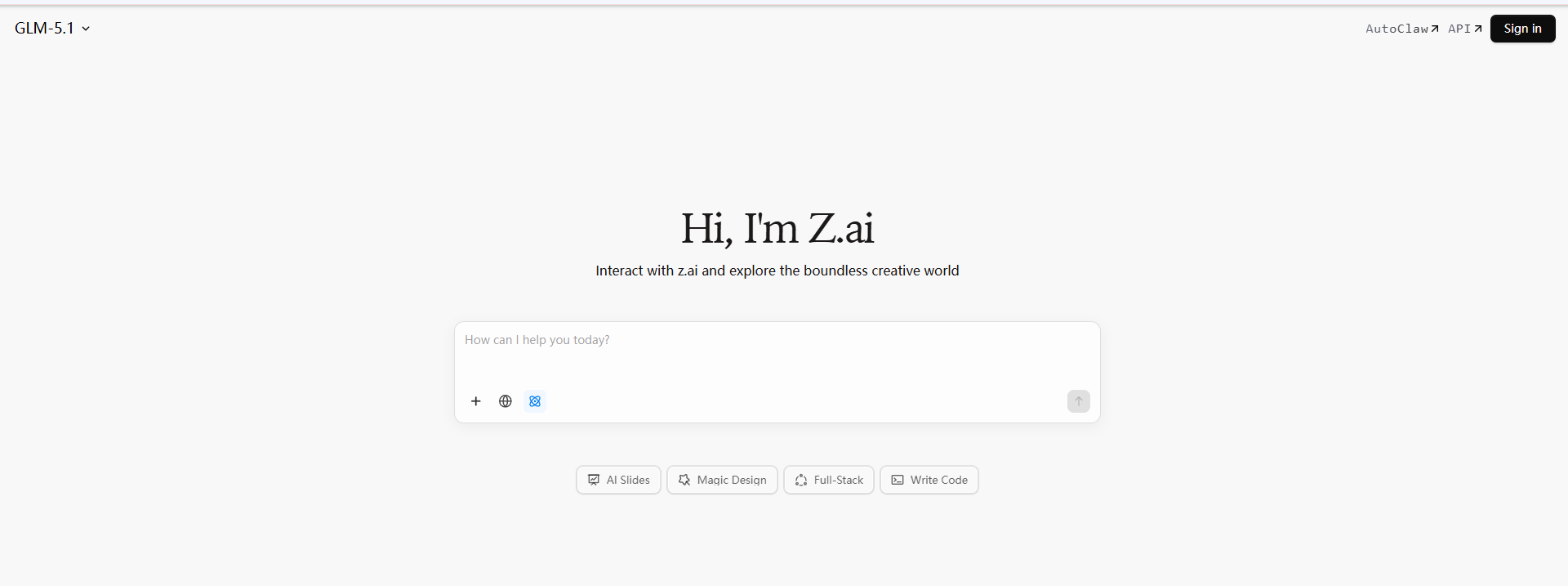
In our testing, we found that Z.ai delivers an experience that genuinely rivals paid alternatives. The flagship GLM-5.1 model now matches the performance of Claude Opus 4.6 on key benchmarks, and the platform includes unique tools like AI Slides generation, full-stack coding agents, and a video generation suite — all accessible from a free chat interface with no sign-up required for basic use. Whether you’re a developer looking for affordable API access, a content creator who needs presentation tools, or simply someone who wants a powerful AI assistant without the monthly subscription, Z.ai deserves a serious look. Try Z.ai free →
What Is Z.ai? The Platform at a Glance
Z.ai is the international-facing brand of Zhipu AI, a company founded in 2019 that grew out of the research lab at Tsinghua University. The company’s core mission — “Inspiring AGI to Benefit Humanity” — drives a strategy built around open-source models, accessible pricing, and multi-modal capabilities. As of early 2026, Z.ai’s models have been adopted by more than 12,000 enterprise customers, deployed across 80 million end-user devices, and used by over 45 million developers worldwide.
The platform offers three main access points:
1. Free Chat Interface (chat.z.ai) — A web-based AI chatbot with no login required for basic use. You can chat with multiple GLM models, generate slides, write code, create designs, and use deep-thinking reasoning mode — all for free.
2. API Services — Developer-facing API with per-token pricing that significantly undercuts most Western competitors. GLM-5 starts at just $0.60 per million input tokens, making it one of the most affordable frontier-tier models available.
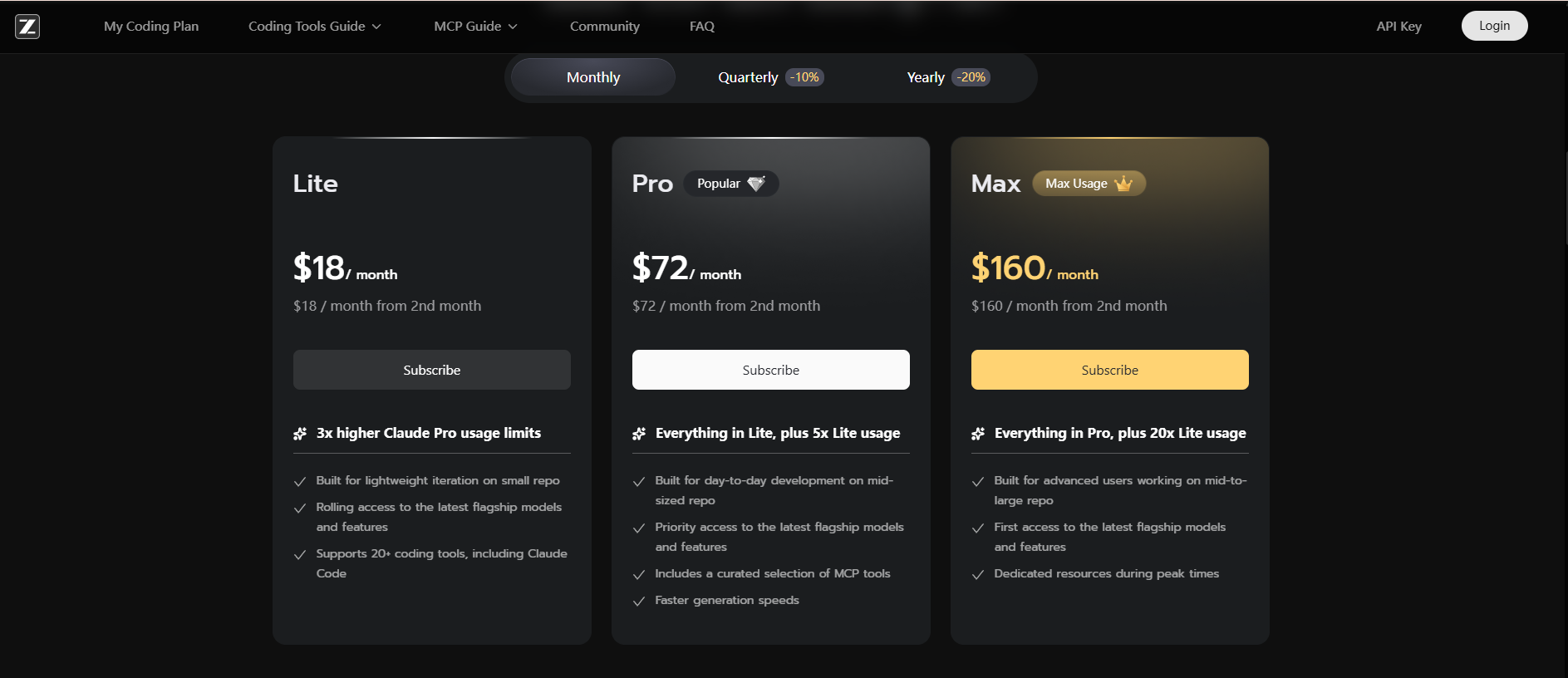
3. Coding Plan Subscription — A dedicated plan for developers starting at $18/month, compatible with 20+ popular AI coding tools, offering high usage quotas and access to the latest models.
What makes Z.ai particularly interesting is the breadth of its model ecosystem. The company develops and maintains language models (GLM series), vision models (CogVLM), image generation models, video generation models (CogVideoX), and speech recognition models — all under one roof. This isn’t just a chatbot company; it’s a full-stack AI platform.
GLM-5.1 — The New Flagship: Matching Claude Opus 4.6
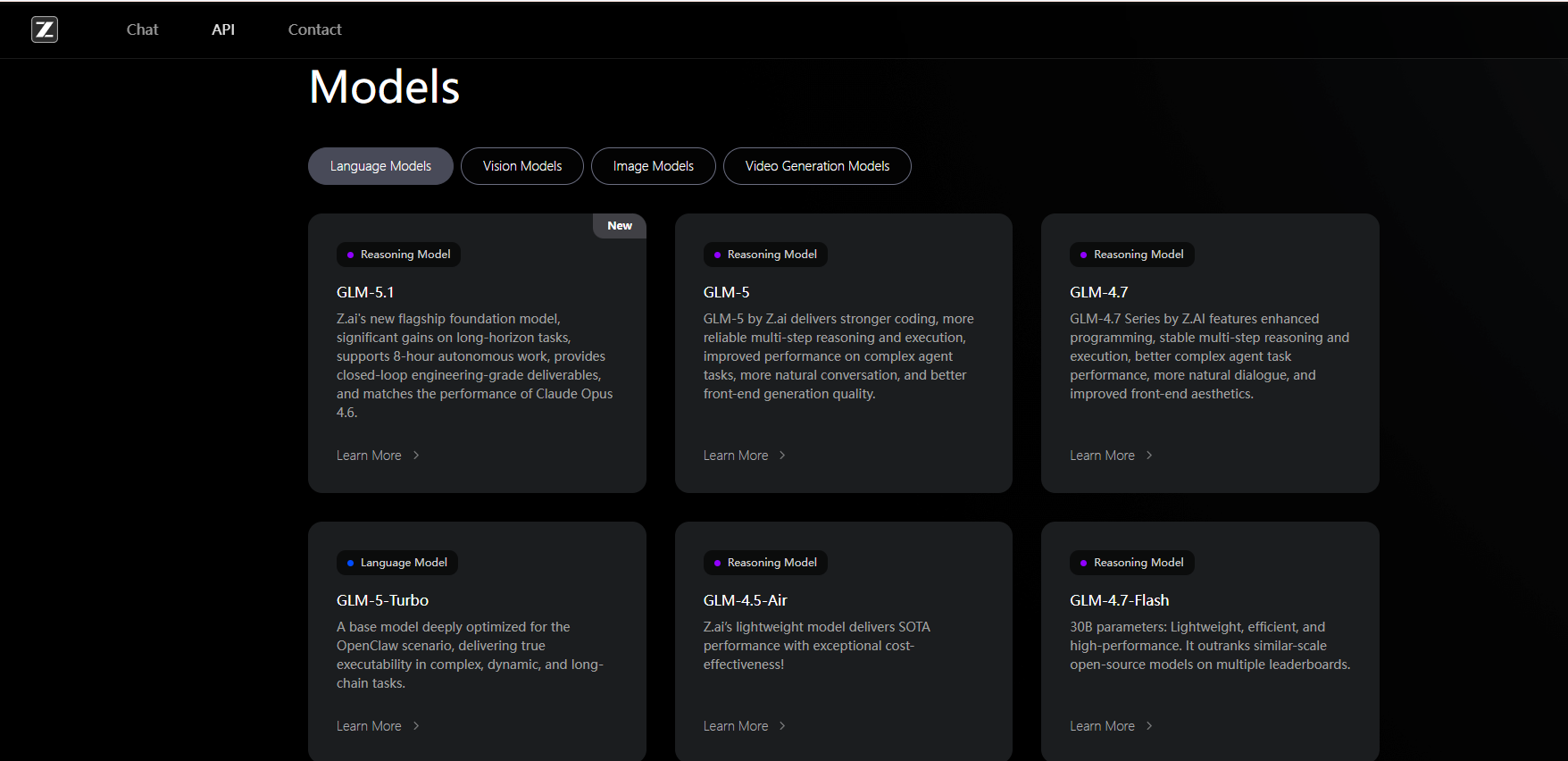
Released on April 8, 2026, GLM-5.1 represents Z.ai’s most ambitious model to date. According to Z.ai’s own documentation, GLM-5.1 “achieves comprehensive capability alignment with Claude Opus 4.6” — a claim that’s backed up by increasingly competitive benchmark scores across coding, math, and multi-step reasoning tasks.
What sets GLM-5.1 apart is its focus on long-horizon autonomous work. The model supports up to 8 hours of sustained autonomous task execution, providing what Z.ai calls “closed-loop engineering-grade deliverables.” In practical terms, this means you can give GLM-5.1 a complex, multi-step project — like building a complete web application from a description — and it will plan, execute, debug, and iterate over an extended period without losing context.
Key capabilities include:
- 203K token context window — enough to process entire codebases, long research papers, or multi-day conversation histories
- Record-low hallucination rate — Z.ai’s research team developed a new reinforcement learning technique called “Slime” that significantly reduces the model’s tendency to generate false information
- Tool use and function calling — native support for integrating with external tools, APIs, and automated workflows
- Multi-turn SFT and RL training — built with supervised fine-tuning and reinforcement learning specifically for sustained, complex task execution
API Pricing: $0.98 per million input tokens / $3.08 per million output tokens — substantially cheaper than Claude Opus 4.6 while offering comparable performance.
Our take: If you’re doing serious development work — building applications, analyzing large codebases, or running complex automated workflows — GLM-5.1 is one of the best value propositions on the market. The 203K context window alone makes it worth considering for projects that exceed the limits of smaller models.
Get started with GLM-5.1 API →
GLM-5 — Open-Source Powerhouse
GLM-5, released in February 2026, is the model that put Z.ai on the global radar as a serious competitor. It was released as fully open-source, making it the first Chinese-developed frontier model to achieve state-of-the-art status among open-weights large language models. The AI community’s reaction was immediate and enthusiastic — multiple researchers described it as a watershed moment for open-source AI.
In our testing, GLM-5 excels at coding, instruction following, and complex multi-step reasoning. The model delivers particularly strong performance on the tau2 benchmark (a measure of agentic capability), and shows reliable behavior when given tool-use tasks. One area where we noticed clear improvement over previous GLM versions is front-end generation — GLM-5 produces cleaner, more visually appealing HTML/CSS code than its predecessors.
The open-source nature of GLM-5 is a major advantage for developers and organizations that need to run models locally or fine-tune them for specific use cases. You can deploy it on your own infrastructure without dependency on Z.ai’s API, giving you full control over data privacy and latency.
API Pricing: $0.60 per million input tokens / $1.92 per million output tokens — one of the most affordable frontier-tier model APIs available anywhere.
GLM-4.7 — The Reliable Workhorse
GLM-4.7 was open-sourced by Z.ai in December 2025 as a new generation model specifically “built for real development workflows.” In Z.ai’s evaluation across 100 real-world instruction-following scenarios, GLM-4.7 showed clear gains in task completion rates and behavioral consistency compared to GLM-4.6.
This model sits in the sweet spot between capability and cost. It’s strong enough for most professional coding tasks, content generation, and data analysis, while being significantly cheaper to run than the flagship GLM-5 series. The GLM-4.7-Flash variant is particularly notable — at just 30B parameters, it outranks similar-scale open-source models on multiple leaderboards while being lightweight enough to run on consumer hardware.
For developers who need reliable, fast responses without paying flagship model prices, GLM-4.7 is an excellent choice. It’s the model we’d recommend for everyday coding assistance, API integrations, and production workloads where cost-efficiency matters.
GLM-5-Turbo — Speed Optimized for Agent Workflows
GLM-5-Turbo is Z.ai’s speed-optimized variant, deeply optimized for what the company calls the “OpenClaw” scenario — essentially, complex, dynamic, long-chain agent tasks where the model needs to execute a series of interconnected actions quickly and reliably.
If you’re building AI agents that need to respond in real-time — customer service bots, automated trading systems, or interactive coding assistants — GLM-5-Turbo delivers faster inference times while maintaining the core reasoning capabilities of the GLM-5 family. It’s not open-source (unlike the base GLM-5), but it’s available through Z.ai’s API at competitive pricing.
API Pricing: $1.20 per million input tokens / $4.00 per million output tokens.
Free Chat Features — More Than Just a Chatbot
The chat.z.ai interface is where most users will first experience Z.ai’s capabilities, and it’s impressively feature-rich for a free product. Here’s what you get without paying anything:
AI Slides Generation — This is arguably Z.ai’s most unique consumer feature. You can describe a presentation topic in natural language, and the AI will generate a complete slide deck with layouts, content, and design. It’s a genuine time-saver for anyone who needs to create presentations regularly, and it’s a feature that most competitors don’t offer in their free chat interfaces.
Full-Stack & Code Agent — The built-in code agent can write, explain, refactor, and debug code across multiple programming languages. In testing, we found it particularly capable with Python and JavaScript, generating clean, well-structured code that often required minimal modification. The model’s ability to handle multi-file projects and explain its reasoning sets it apart from basic code completion tools.
Magic Design — A visual design tool that generates graphics and visual content from text descriptions. Useful for creating social media graphics, simple logos, or visual assets for presentations.
Deep Think Mode — Toggle this on for complex reasoning tasks. The model spends more time “thinking” before responding, which produces significantly better results for math problems, multi-step logic, and detailed analysis.
AutoClaw Agent Mode — An autonomous agent that can perform multi-step tasks like researching a topic, writing a report, and formatting the output — all from a single prompt. This is where the GLM models’ strong agentic capabilities really shine.
No sign-up required — You can start using Z.ai’s chat immediately without creating an account. This is a refreshing approach in a market where most competitors require email verification, phone numbers, or credit cards before you can try their product.
Try Z.ai Chat free — no sign-up required →
API Pricing Comparison
Z.ai’s API pricing is one of its strongest competitive advantages. Here’s how the model lineup compares:
| Model | Input (per 1M tokens) | Output (per 1M tokens) | Context Window | Best For |
|---|---|---|---|---|
| GLM-5.1 | $0.98 | $3.08 | 203K | Complex autonomous tasks, code generation |
| GLM-5 | $0.60 | $1.92 | 203K | General reasoning, coding, open-source use |
| GLM-5-Turbo | $1.20 | $4.00 | 203K | Real-time agent workflows |
| GLM-4.5-Air | Low cost | Low cost | 128K | Cost-efficient Q&A, classification |
| GLM-4.7-Flash | Free tier | Free tier | 128K | Lightweight tasks, edge deployment |
For comparison, Claude Opus 4.6 charges roughly $15 per million input tokens and $75 per million output tokens — making GLM-5 about 25x cheaper on input and 39x cheaper on output while delivering comparable benchmark performance. Even GLM-5.1, the most expensive Z.ai model, costs a fraction of what you’d pay for equivalent capability from Western providers.
Pros and Cons
Pros:
- Genuinely free chat interface with no sign-up required — rare among frontier AI platforms
- Exceptional API pricing — GLM-5 at $0.60/1M input tokens is among the cheapest frontier-tier options available
- Open-source models — GLM-5 and GLM-4.7 are fully open-weight, enabling local deployment and fine-tuning
- Unique features — AI Slides, Magic Design, and AutoClaw agent mode differentiate Z.ai from competitors
- Strong coding performance — GLM models consistently rank highly on coding benchmarks
- Massive context window — 203K tokens across the flagship models handles long documents and codebases
- Enterprise credibility — 12,000+ enterprise customers, publicly listed company
- Coding Plan at $18/mo — compatible with 20+ AI coding tools like Claude Code
Cons:
- Limited vision capabilities — GLM-5 lacks native vision support; you need separate vision models
- Customer service concerns — some users report slow or unresponsive support via email and Discord
- Less enterprise adoption outside China — Western enterprise ecosystem integration is still developing
- Provider accessibility — some users outside China may experience latency or access issues
Who Should Use Z.ai?
Developers on a budget: If you’re building AI-powered applications and want frontier-tier model performance without the frontier-tier price tag, Z.ai’s API is one of the best deals in the market. Start with GLM-5 for general tasks and upgrade to GLM-5.1 for complex projects.
Open-source advocates: If you need to run models on your own infrastructure — for privacy, compliance, or performance reasons — GLM-5 and GLM-4.7 give you frontier capabilities with full control.
Students and educators: The free chat interface with no sign-up requirement makes Z.ai one of the most accessible AI tools for learning. The AI Slides feature is particularly useful for creating study materials and presentations.
Content creators: The combination of free chat, slide generation, design tools, and deep-thinking reasoning mode makes Z.ai a versatile creative toolkit — especially for creators who need AI assistance but can’t justify $20/month subscriptions.
Startups and SMBs: The Coding Plan at $18/month with compatibility across 20+ AI coding tools offers excellent value for small teams that need to move fast without burning through their budget.
Frequently Asked Questions
Is Z.ai really free?
Yes, the chat interface at chat.z.ai is free to use with no account required for basic access. You can chat with GLM models, use AI Slides, generate code, and access deep-thinking mode without paying anything. Advanced features and higher usage limits may require a subscription.
How does GLM-5 compare to ChatGPT and Claude?
GLM-5 and GLM-5.1 are competitive with top-tier models on coding and reasoning benchmarks. GLM-5.1 specifically claims capability alignment with Claude Opus 4.6. The key difference is price — Z.ai’s models cost a fraction of what OpenAI or Anthropic charge for similar performance, and GLM-5 is fully open-source.
Can I use Z.ai’s models locally?
Yes. GLM-5 and GLM-4.7 are open-source with publicly available weights. You can download and run them on your own hardware, which gives you full control over data privacy and eliminates API dependency. The GLM-4.7-Flash variant (30B parameters) is particularly well-suited for consumer hardware.
What is the Coding Plan?
Z.ai offers a dedicated Coding Plan starting at $18/month that’s compatible with 20+ popular AI coding tools, including Claude Code. It provides high usage quotas and access to the latest GLM models, making it an affordable alternative to more expensive developer subscriptions.
Is my data safe with Z.ai?
Z.ai is a publicly listed company subject to regulatory oversight. For maximum data privacy, you can use the open-source models (GLM-5, GLM-4.7) locally on your own infrastructure, which eliminates any data transmission to external servers.
Does Z.ai support languages other than English?
Yes. The GLM models have strong multilingual support, with particularly good performance in English and Chinese. Users across forums consistently praise Z.ai’s contextual understanding and fluency across multiple languages.
Final Verdict: Is Z.ai Worth Your Time?
After extensive testing, our answer is a clear yes — especially if you’re cost-conscious or interested in open-source AI. Z.ai offers a rare combination: frontier-tier model performance at a fraction of the cost of Western competitors, with genuinely useful free tools that don’t require an account to try. The GLM-5 series has proven itself as a legitimate competitor to models from far more expensive platforms, and the open-source availability of GLM-5 and GLM-4.7 gives developers and organizations an option that simply doesn’t exist from OpenAI or Anthropic.
The platform isn’t perfect — customer support needs improvement, vision capabilities lag behind some competitors, and Western enterprise adoption is still early. But for individual developers, startups, students, and anyone who wants powerful AI without the premium price tag, Z.ai is one of the most compelling options available in 2026.
Start with the free chat interface to see if it fits your workflow, then explore the API or Coding Plan when you need more. Get started with Z.ai today →